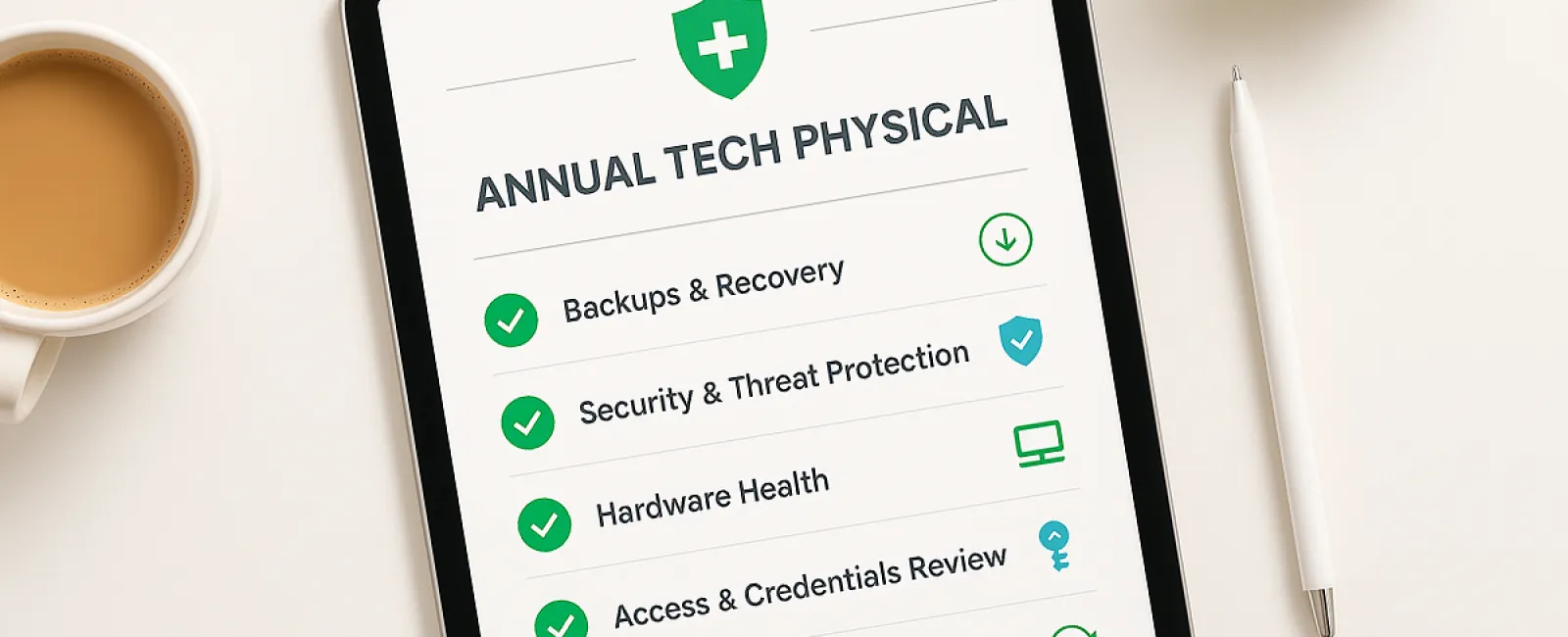
January has a way of bringing neglected things back onto the list.
You finally book the doctor's appointment.
Schedule the dentist.
Maybe even get that strange noise in your car checked before it turns into something expensive.
Preventive care isn't exciting — but it's a lot cheaper than an emergency.
The same idea applies to technology for your Boston business, even though it's often easier to ignore.
So here's the uncomfortable question:
When was the last time your business technology had a real health check?
Not a quick fix for a printer or a rushed response when something broke — but a full look at how healthy your systems actually are.
Because "everything is working" isn't the same as "everything is fine."
Want to set up a health check for your Boston business? Book a discovery call today.
The Problem with the "We Feel Fine" Mentality
Most people skip checkups because they don't feel sick.
Businesses do the same thing with technology.
Common reasons we hear across Greater Boston:
-
"Everything's working."
-
"We're too busy right now."
-
"We'll deal with issues when they come up."
The trouble is that technology problems rarely announce themselves ahead of time.
Just like high blood pressure, many issues stay hidden until they become urgent — and expensive.
The most common causes of major tech failures aren't surprises. They're usually:
-
Known risks that were postponed
-
Aging equipment that finally gives out
-
Backups that exist but don't restore properly
-
Former employees who still have access
-
Compliance gaps no one has revisited in years
On the surface, things look fine. Underneath, pressure is building.
What a Comprehensive Tech Physical Entails
A proper technology assessment works like a medical exam. It's methodical, not dramatic — and it focuses on what you can't see day to day.
Here's what actually matters.
Critical Metrics: Backup and Disaster Recovery
If everything else failed, how quickly could you recover?
Most businesses assume backups are working — until the moment they need them.
Important questions:
-
Are backups completing successfully, or just scheduled?
-
When was the last time a file was actually restored as a test?
-
If a server went down at 9 a.m. on a Monday, how soon would you be operational again?
Too many Massachusetts businesses discover backup failures during an outage — the technology equivalent of airbags not deploying in a crash.
Infrastructure Health: Hardware and Systems
Technology doesn't usually fail suddenly. It ages.
Servers slow down. Firewalls fall out of support. Workstations limp along until the wrong update pushes them over the edge.
Ask yourself:
-
How old is your critical hardware?
-
Are any systems beyond manufacturer support?
-
Are updates applied proactively or only after problems show up?
Massachusetts has a lot of older office buildings and outdated infrastructure is one of the most common — and most preventable — causes of downtime.
Security Check: Access Controls and Credentials
If you can't quickly answer who has access to your systems, that's a risk.
Key questions:
-
Can you list every active user?
-
Are former employees or vendors still enabled?
-
Are shared logins being used "just to make things easier"?
Unchecked access growth is one of the most common security weaknesses in small businesses — not because people don't care, but because it's easy to lose track when everyone is busy.
Disaster Preparedness: Emergency Planning
No one likes planning for worst-case scenarios, but hoping you'll "figure it out" under pressure isn't a strategy.
Consider:
-
Do you have a documented response if ransomware hits?
-
Has anyone reviewed or tested that plan recently?
-
How long can you realistically operate without core systems?
If the plan can't be found quickly, it's not a usable plan.
Regulatory Compliance: Industry-Specific Standards
Many Boston businesses are subject to requirements whether they think about them or not.
-
Healthcare providers face HIPAA penalties that can reach $50,000 per incident.
-
Businesses that process credit cards must meet PCI standards to keep payment access.
-
Client contracts increasingly include enforceable security requirements.
Compliance isn't theoretical — it's contractual, financial, and very real.
Signs You're Due for a Tech Checkup
If any of these sound familiar, it's probably time:
-
"I think our backups are working."
-
"The server is old, but it's still running."
-
"We might still have ex-employees in the system."
-
"Our disaster plan exists… somewhere."
-
"If one specific person left, we'd be in trouble."
-
"We'd probably fail an audit, but no one's asked yet."
None of these mean disaster is imminent, but risk is slowly growing inside of your business.
Want to schedule a tech checkup for your Boston Business? Book a discovery call today.
The Price of Ignoring Maintenance
A tech checkup takes just a few hours.
A system failure can cost days, weeks, or even jeopardize your entire business.
The stakes are high and costs will add up quickly:
Data loss that can't be undone
-
Downtime that stalls revenue and erodes trust
-
Compliance penalties that hit unexpectedly
-
Ransomware recovery that often reaches six figures for small businesses
Prevention isn't exciting. But it's far cheaper — and far less stressful — than cleanup.
Why Self-Assessments Aren't Enough
You wouldn't diagnose your own health with guesswork. You rely on someone who sees patterns across many patients.
Technology is no different.
An experienced IT partner like Systems Support brings:
-
A clear understanding of what "healthy" looks like for your industry and size
-
Familiarity with the failures that happen most often — and how to spot them early
-
Fresh eyes that notice risks insiders have learned to work around
That's what real prevention looks like.
Book Your Annual Tech Health Exam Today
January is when most preventive care gets scheduled. Your business technology deserves the same attention.
An Annual Tech Health Exam provides a clear picture of:
-
What's working
-
What's aging
-
What's exposed
-
What deserves attention now — and what can wait
No pressure. No jargon. Just a straightforward assessment and practical guidance.
Because the best time to find technology problems is before they become emergencies.
And for most businesses across Greater Boston, that time is now.
Click here or give us a call at 781-837-0069 to book your 15-Minute Discovery Call.
Summary:
Many small and mid-sized businesses across Greater Boston and the South Shore delay proactive IT maintenance because their systems appear to be working. However, hidden issues like aging hardware, untested backups, unmanaged user access, and undocumented disaster plans often go unnoticed until they cause costly downtime or security incidents. A comprehensive technology checkup helps businesses identify these risks early, improve resilience, and stay compliant without major disruptions. Preventive IT assessments are a practical way to reduce downtime, protect data, and avoid emergency repairs.